Just a little note to any subscribers or regular visitors that I haven’t forgotten you. I’m fine and I’m not giving up blogging just yet! I’m just enjoying Easter holidays with my schoolboy who is rather good company these days.
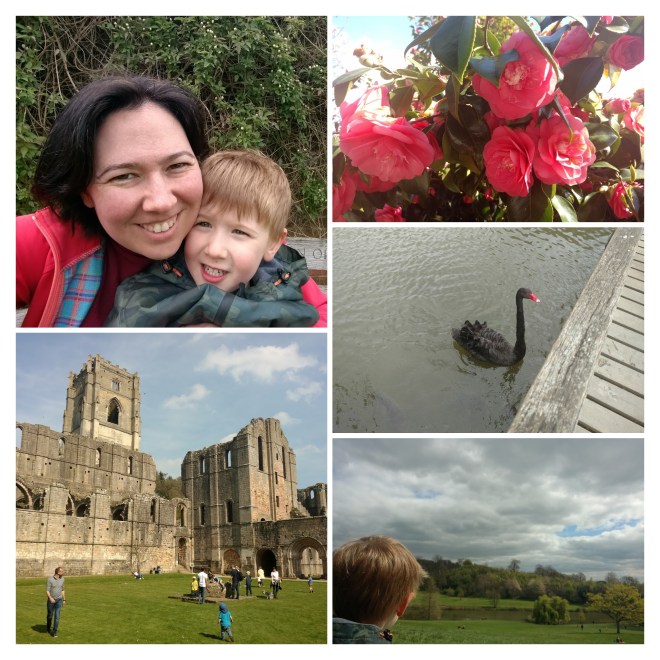
We’ve visited Fountains Abbey in North Yorkshire, Coram’s Fields, the British Museum, and Chartwell so far! We’ve also been playing quite a bit of Lego Star Wars on the Nintendo.
I’ll be back from Tuesday onwards with plenty of new stuff, including some posts about our days out and our shiny new National Trust membership. It’s burning a hole in my pocket because I want to be sure I get my money’s worth!
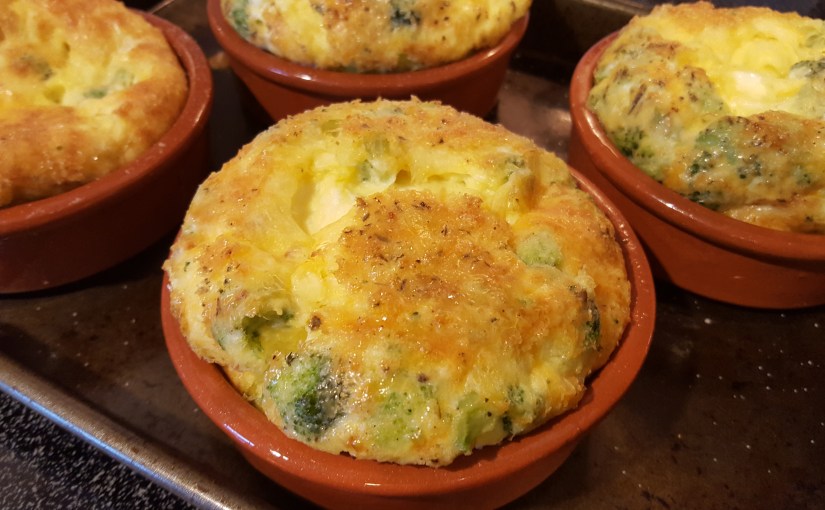
Quiche is a brilliant breakfast. The savoury protein kick is just what the busy mom ordered. My husband is gluten intolerant – not just fad-style – but genuinely cannot indulge in a white flour crust. I am actually adverse to pie crust; I’ve never found it necessary and prefer to scoop out any filling I encounter. I understand many enjoy this mythical flaky, buttery crust that isn’t soggy or tasteless, so you’re welcome to use this filling recipe with a ready-made crust if you like. I prefer to go crustless. It’s faster, healthier and so much easier to serve!
For this recipe, I use greased ramekins to create easy portions and cut down on the baking time. You can fill a pie dish instead, but you’ll need to double the baking time and possibly cover with foil for the last 15 minutes to prevent it burning on top. I use Canadian bacon, pre-cooked rounds of back bacon that are easy to chop into pieces and fry off to add some flavour. You could easily use turkey bacon or ham to keep it lean, or back or streaky bacon if you have the time to cook it first. By using pre-cooked bacon, I only need a minute to give it some colour and it’s ready for the quiche.
In the spirit of super fast, I also use frozen chopped broccoli. I let it thaw for a minute before adding it to the bacon pan to help the remaining water evaporate and keep the quiche getting too soggy. Trust me, this added step will add flavour and firmness to your tart, so don’t skip this for the sake of one frying pan.
This is the perfect weekend morning dish to go along with some fresh fruit and toast, or you can make some extras for a quick midweek warm up. My kids love this, and my husband appreciates the lack of crust as much as I do. Give it a try and you’ll see why!
You’ll need:
4 ramekins greased with a tab of butter each
8–10 eggs
¼-–½ cup chopped broccoli (I use frozen)
½ cup chopped, cooked bacon (I use Canadian bacon rounds)
½ cup shredded cheese of choice (I prefer a sharp cheddar)
¼ cup milk
½ teaspoon garlic powder (I use a garlic and herb blend)
½ teaspoon salt
½ teaspoon pepper
The method:
Pre-heat your oven to 190C/375F.
Measure out your broccoli and set it aside to begin to thaw.
Chop your bacon into small pieces and add to a warmed pan over medium heat. Allow the bits to lightly fry for about a minute.
Add the slightly-thawed broccoli and allow to thaw further with the bacon. Allow any moisture from the broccoli a chance to steam off. This usually only takes two or three minutes.
Place your ramekins onto a baking tray and add a tab of butter to each before putting them into the oven.
Break your eggs into a nice large bowl and scramble them well before adding the splash of milk. Beat in the dry spices and set aside.
Remove the ramekins from the oven and give them a little swirl to spread the butter around the edges.
Layer a bit of bacon and broccoli into the bottom of each ramekin before pouring the egg mixture to cover the bits.
Add a pinch of shredded cheese to the top of each quiche and use a fork to gently push down slightly below the egg.
Slide your baking tray of quiches into the oven for about 20 minutes. Depending on the size of the individual ramekins, it may take slightly longer. Once the quiches are puffing up, they’re only a few minutes from finished.
Allow the quiche to cool for about 5 minutes after removing from the oven, they may sink slightly, but no worries. The individual quiche can be served with or without accompaniments – sometimes they never make it to a plate! Enjoy!
One of my blogger friends who joins in with the #EatSleepBlogRT linky every week linked up a funny post the other week. It had a fact about her for each letter of the alphabet, and I really enjoyed learning more about her in a format that required her to be a bit more creative in how she expressed it. I commented that I’d really like to copy the idea and so she turned it into a tag post!
So here you are, an alphabetical description of some things that are important parts of my personality. To read the original post that started it all, and see more instructions for joining this tag, please check out Heather’s blog, Shank You Very Much.
A is for acting
My childhood dream was to be a musical theatre star, but I never pursued it.
B is for boobs
My boobs are my favourite feature of mine. They aren’t quite what they used to be. They’ve been subjected to pregnancy and breastfeeding and 30-mumble years of gravity. But they’re still mine and they’re great.
C is for cats
I like black & white cats who occasionally bite you when you may or may not deserve it.
I was brought up by my dad, and he did a smashing job really. Respect to all the solo parents out there doing it for themselves.
E is for Editor
In my day job, I am an editor. It’s not quite the acting dream, but I actually really love it. I dabbled with a lot of other possible professions in my younger days but I was always meant to be an editor.
F is for (the F-word)
I really love swearing. I like doing it and hearing other people doing it (as long as it’s comical/therapeutic and not aggressive). I don’t like to swear on my blog, but if you come round for a drink after the kids are in bed we can turn the air blue.
G is for Geek Groupie
I like a few geeky things like Star Trek, Lord of the Rings and other fantasy books & movies, Comic Book movies etc. But I’ve never quite been passionate enough about any of it to qualify to be a true geek. More so, I’ve always enjoyed the company of people geekier than me – and pretty much everyone I’ve ever dated has been a geek of some type. So that’s why I say I’m a bit of a geek groupie.
H is for Hats
I like to wear very warm, flamboyant hats in the winter. I get away with not blow-drying my hair and just sticking a hat on it. My mother-in-law bought me a real winner this year, and my son is taking after me.
I is for Indian food
I am obsessed with any sort of Indian food, from whatever region, authentic or not. Exotic spice combinations are my happy place.
J is for Japanese
I’m also obsessed with Japanese food. Sushi, Teriyaki, Udon – all of it. I NEED to eat it at least once a week. When I was a teenager my dad had a similar obsession, for which I ridiculed him. But it must be in the genes because now I can’t get enough of the stuff. I also find Japanese language and culture fascinating – have studied it a bit – and hope to visit Japan properly one day.
K is for Kitchen
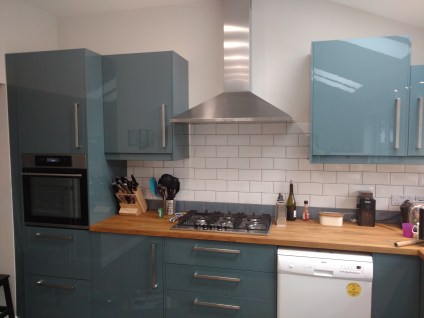
We recently built an extension to our house with a brand new shiny kitchen in it. I’ve always wanted a breakfast bar and now I have one! We have worked for years to be able to get such a thing. When I’m feeling a bit down, it’s wonderful to have a part of my house that is shiny, uncluttered, and just how I like it (unlike the rest of the house).
L is for Listening
As I’ve grown older, I’ve realised how important it is to listen. I’m sometimes good at listening to my friends when they need a friendly ear. But other times I’m too self-centred and I forget to listen and think of others. It’s something I’m working on.
M is for Mindfulness
I am still new to mindfulness but I’m learning it’s a wonderful thing for my physical and mental health. It was actually another blogger who got me interested in it. If you want to know more about my new interest, check out my guest post on Mission: Mindfulness.
N is for Nicole
It’s my name … and I can’t think of anything else for this letter.
O is for Only You
My favourite cheeseball movie guilty pleasure from 1994. It stars Marisa Tomei, Bonnie Hunt and Robert Downey Jr before he was Iron Man. It’s about a woman who goes all the way to Italy chasing after a man who an Ouija Board told her was her soulmate. It’s full of beautiful scenery, cheesy lines, cringey comedy and good kisses. I will never get tired of watching it.
P is for PhD
It is a lesser known fact that I have a PhD in English. My thesis was about religion and postcolonial literature. I don’t remember much else about it.
Q is for Questions
Another of my current intentions for myself is to ask people more questions. I talk about myself too much and forget to ask other people things. So I’m trying to think about what I’d like to ask my friends. But I also have to be careful and not ask the wrong sorts of questions!
R is for Rock ‘n Roll
My music tastes are very eclectic. But if someone forced me to pick one, it would have to be rock. There is nothing like a rousing guitar riff. Plus there are so many sub-genres of rock, I’m sure I wouldn’t get bored.
S is for Sugar
The sugar police can go and drown themselves in a massive avocado smoothie as far as I’m concerned. I love sugar. Sugar in my drinks. Sugar in my cakes. The current trend of “giving up sugar” makes me roll my eyes so hard it gives me a headache. It’s definitely bad to eat too much of the stuff, but that doesn’t mean it’s always bad.
T is for Truth
I am truthful about things to a fault. Perhaps the T could also be for Tactless, but I’d like to think I’ve gotten better about that over the years!
This is a real thing and they are bloody amazing. They play all sorts of songs on a collection of different sized ukuleles, with a strong dose of humour. Seeing Kate Bush’s song “Wuthering Heights” performed on ukuleles made my life complete.
That’s a fancy medical term for fainting. If I hurt myself and I think it’s really bad – like broken bones, gashes, or just extreme pain – I faint. I just check out. I also faint if I don’t lie down when they draw my blood for blood tests. It scares the bejeezus out of people.
W is for Wuthering Heights
If someone asks me what my favourite book is, I always say Wuthering Heights. Of course, I first read it when I was an impressionable, angsty teenager and I just thought it was the most romantic story ever. In my more mature years, I actually think Cathy is sort of an idiot. But I haven’t found another book that has made quite so strong an impression on me.
X is for Xylophone
I don’t really care about xylophones, but there aren’t very many words that start with x.
Y is for Youth is wasted on the young
Do you ever look back at pictures of yourself and think: “Damn, I looked good and had no responsibilities, but I never appreciated it at the time?” I do. I also think how much I would love to sit around studying maths and history, whereas as a teenager I thought it all mind-meltingly boring. It’s a shame that we have to go to school when we’re too young to appreciate it.
Z is for Zippers
When zippers stop working properly and come unzipped from the bottom underneath the pull tab. That just sets my teeth on edge. Aaaagggh.
I’m tagging Becki from The Mum From Brum, Nadia from Scandi Mummy and Jen from Just Average Jen to participate next. I hope you’ll all let me know when your posts are live so I can have a read.
The rules are here:
Read through my post. I know, that seems like a given.
Start your own blog post.
Fill your alphabet in with things that describe you. Or just random thoughts that start with that letter if your brain decides it doesn’t feel like cooperating.
Tag the person who sent this to you and two other bloggers that you’d like to know more about.
Copy and paste these directions above your post so people know what to do.
Sometimes, life is just a bit too much. Sometimes things are a bit crap. I’m not going to define what crap is. It might be catastrophically crap; it might be an everyday, yet relentless sort of crap. But it happens to all of us.
My current sort of crap is the type that is little things piled on top big things that all conspire to crush me.
The big one, as I’ve mentioned on this blog before, is that my grandmother is dying. She brought me up when I was little and is one of the people I love most in the world. She has been unresponsive for months now and we’re finally moving her into hospice care. It has been difficult: missing her already but not feeling I’m allowed to grieve until she’s truly all-the-way gone. And I have yet before me the task of learning how to exist in a world without her in it.
The second biggest one is that I keep having these weird episodes in which my heart pounds and races. The other day one of the episodes lasted a full 10 minutes and my Fitbit said my heart rate was 194 bpm. I ended up spending that night in A&E, but they didn’t find anything wrong beyond a slight arrhythmia – which is apparently pretty common. So I’ve been worried about my health. Do I have a heart problem or is a stress/anxiety thing? I don’t know yet.
And then there are lots of other little/big things. Getting called in by the headteacher at school to meet about my son’s “behavioural issues”. The mum that snubbed me at the school gates. Running behind with work deadlines. Feeling emotional at work and fighting back tears at ridiculously inappropriate moments. Feeling fed up with blogging and yet not truly wanting to quit.
I’m sure all of you can relate to some of this. Big problems, little problems, 1st world problems – whatever. There is no hierarchy of problems. The fact is: if they are upsetting you, affecting you, making it difficult for you to function as you would wish, then they are significant.
Ignoring these things, downplaying them and telling yourself to get over it is not going to help. You need to confront these feelings head on. To say, “this is the way I’m feeling, and that’s okay”.
But at the same time, we all have a lot on our plates. I know there have been days when all I wanted to do was curl up on the floor and wallow in my grief. But I didn’t. Because I couldn’t. I’ve got small people to look after. And if I lay down on the floor they are going to jump on top of me and demand to be flown around in the air.
I have a job that needs doing because I have a mortgage that needs paying. I have other friends and family that need me to be there for them. As much as I’d like to, I just can’t give up. I can’t mentally check out and take a holiday from all of my responsibilities.
And so the pressure of all of my troubles weigh on me and are compounded by my need to keep on going even when I want to quit.
But the other day, after I’d spent the night in A&E – when I felt tired and lost and lonely and sad and fed up – I had a revelation. My husband was at work. My kids were at school and nursery. I’d called in sick to work because I’d been awake all night in hospital. And when my grief pricked me in the eye, I let it. There was no one there to see.
So I cried.
But I didn’t cry like a grownup. I didn’t cry the way you cry at a sad movie, with tears running down your face quietly and the odd little hiccup. I didn’t cry the way you do in front of other people, when you are desperately trying to stop – trying to hide it – apologising for your crass display of emotion.
I cried like a child. I screamed. I moaned and groaned and probably sounded much like a cow giving birth. Nobody could hear me. So I let every messy feeling pour out in tears and great wracking sobs.
And when my tears dried up and I was tired of railing against the universe, I simply stopped. And it was like a great weight had been lifted.
I’ve since been doing a bit of googling about crying and apparently there is scientific evidence that crying releases stress. Tears actually contain stress hormones that are leaving your body when you let them go.
Ever since my big cry, everything has seemed easier. I’m not crying at work anymore. I’m not feeling as tense around my family. I’m able to keep doing what I need to do while I weather my personal storms. I had thought if I didn’t cry, I was being strong. But really I was stifling all of the emotions that scared me, instead of facing them. When I didn’t let them out, they festered.
So I’m not going to start making crying one of my big hobbies. But it’s comforting to know that I can – and should – cry when I need to.
Crying is okay AND it helps. So the next time it’s all a bit (or more than a bit) crap, send the family out of the house, close the curtains, put the kettle on, and let the tears flow.
I love going to the cinema. The atmosphere, the big screen, the snacks – even the other people (believe it or not) – all add to a sense of occasion for me. There’s a lot to be said for watching your TV at home, but it will never be as special or exciting as sitting in front of the big screen.
But I very rarely get to go … because I have a 2 year old. Occasionally, I sneak off on my own or with an adult friend, and recently have taken my 4 year old to a couple of appropriate features. But while my toddler might pay a bit of attention to a Disney film on the TV at home, there is NO way he would sit through something at the cinema. At home, he can toddle off to play with trains when the film gets boring for him, but in the cinema he would need to stay put.
So I was pretty sceptical when I was recently invited to bring my 2 year old to a cinema premiere. I envisioned myself chasing him amongst the rows of chairs while he giggled hysterically, stepping on people’s toes and making me wish I’d brought a hip flask with me.
But this film was made for 2 year olds. Peppa Pig: My First Cinema Experience opens on 7 April and is the perfect opportunity for families to enjoy the cinema together without needing a babysitter for the toddler.
The film is based around 6 brand new, short Peppa Pig episodes, and they are strung together by interactive interludes in which a children’s presenter and some Peppa Pig puppets encourage the children to sing and dance. This is a great strategy to reduce the problem of short attention spans. The kids enjoy the episodes just like they would on the telly, and then they get a break with something different that gives them a chance to move around. The whole thing lasts about an hour.
My 2 year old is a very active, physical little boy and he sat through almost the whole thing. He got a bit restless in the last 10 minutes or so. But I was amazed that he sat as long as he did. He was entranced by the Peppa episodes and he enthusiastically joined in with the singing and dancing during the interludes.
And surprisingly, I wasn’t bored either. I had been joking along with my other blogger friends who attended that we needed to hide some wine in our handbags so we wouldn’t die of boredom. But actually you could tell that the writers had thought about the parents. There was lots of humour that appealed to me as a (slightly) grownup person – especially in the episode in which the Queen steals a double-decker bus. Check out the trailer here:
So when the Easter holidays are inevitably doused by buckets of rain, you now have an option to hide in a darkened room eating untold amounts of snacks. Some cinemas even do sell wine, completely legitimately. And you can take your very young children without fearing they will terrorise the other punters.
I recently took my two boys, aged 2 and 4 at the time, to Disneyland Paris (DLP). As I mentioned in a previous post in which I discussed some ideas for booking your trip, you need to plan ahead in order to make the most of a short break to DLP. The park is so big and so busy. Add young children into the mix and you have a recipe for a pretty chaotic (and not at all relaxing) break. We wasted so much time wandering around aimlessly, being indecisive. I’d like to spare you from that.
Take some time to think about what you want from your DLP holiday, and you will be rewarded with that feeling of time well spent. Here are my tips to help you plan.
Bring a pushchair and/or a sling
The parks are so big. It takes about 15 minutes just to walk from the car park to the entrance (and this is also true if you’re staying on an on-site hotel – you could get a shuttle but either way, it’s time-consuming). We brought our double buggy so that both the 2yo and 4yo could be pushed along. It was a total lifesaver. We never would have gotten anywhere walking at my 4yo’s pace, and he would have tired very quickly.
For the 2yo, I also wished I still had my old hippy sling that he would have still fit in. This is because you can’t bring a pushchair while you’re queueing for rides, and most queues are at least 30 minutes long. My 2yo didn’t like standing on the ground among all the people taller than him, so my husband and I ended up carrying him for the entire queue. That is a recipe for very sore arms. If your child is young enough to fit in a carrying device, then use one!
Pack smart
You want to bring two small bags – one of which should be a rucksack or otherwise easy to carry with no hands. In one bag, stick things that aren’t valuable, such as all of your nappy changing items, bibs & other lunching items, and any spare clothing/extra layers you might need. You can leave this bag in your pushchair while you are queuing for rides. In the rucksack, put drinks, snacks and maybe a tablet. You need these things to stop the kids melting down in the queue. And don’t worry, you can take your rucksack on the rides.
The lockers at DLP are located outside the entrance to the park, which is utterly inconvenient, so I wouldn’t count on being able to use those.
Get an early start and use your Extra Magic Hours
If you’re staying at a DLP hotel (which I highly recommend), you will have access to Extra Magic Hours. This allows you access to the parks from 8am – before the general public is admitted at 10am. You would be a fool to miss out on these. But your hotel is likely to tempt you with breakfast, which usually isn’t available until 7:30am at the earliest. If you wait for breakfast, you will miss the Extra Magic Hours.
I recommend stockpiling snacks to eat first thing in the morning (or, if you stay in the self-catering Davy Crockett Ranch, you have a kitchen in which you could stock some proper breakfast items of your own). Have an early snack, and then aim to arrive at the park entrance no later than 7:45. You need the extra time to walk through the vast empty spaces and get through security, in order to get into the park first thing at 8am.
You can always then have brunch or another treat after you’ve taken advantage of the Magic Hours.
Rides to hit during Magic Hours
There are limited rides open during Magic Hours, usually only in the Disneyland park and not the Walt Disney Studios park. These are subject to change, but I suspect it’s vaguely the same most of the time. During Magic Hours, you should make a beeline for the rides that tend to have the longest queues. In my experience, here they are in order of priority (i.e. the usual longest queues first).
Buzz Lightyear Laser Blast
Peter Pan’s Flight
Les Voyages de Pinocchio
Blanche-Neige et les Sept Nains (Snow White)
Orbitron
There are others that are open too. I would recommend doing Magic Hours rides only during Magic Hours, thus freeing up time for the other rides during the normal park hours.
Take advantage of being first in the park
The other advantage to Magic Hours is that you will be in the park first thing when all of the other rides open, before the general public manage to cross the great expanse of asphalt to get the heart of the park. So, you should set your sights on a popular ride, and make sure you are waiting at it’s entrance at exactly 10am, or a few minutes before. Then you will be first in the queue as soon as it opens. Generally, any ride that is eligible for Fast Pass entry is likely to be one the popular ones (your Disney map will tell you which these are).
Using the Fast Pass system
Certain rides have little kiosks near the entrance. You scan your park tickets there, and receive a pass with a timed entry to the ride, which will allow you to jump the queue.
The important thing to know about Fast Passes is that they run out. You need to get one first thing in the morning (or as early as possible), otherwise you might not get one at all. If you get one as close to 10am as possible, you should be able to ride that ride by around lunchtime. Any later, and you’ll be lucky to get a ride by 5pm.
When you have a fast pass, you can’t get another one straight away. You have to wait a few hours. The fast pass you have will tell you when you’re allowed to get another one.
Naptime plans
If, like me, you have two kids and only one that still naps, you should have an action plan for naptime. Our 2yo napped in the buggy after lunch, and this was a great opportunity for the older one to go on the rides that his brother was too short for, or to queue for photos with Disney characters or perhaps have a nose round some shops. The Adventureland section of the Disneyland park is also a great place for naptime, as it’s mostly play areas and things you have to climb on – not necessarily great for 2yos or younger.
If you are in the Walt Disney Studios section of the park, there are usually big shows in the main backlot around naptime (for us it was the slightly underwhelming Star Wars Stormtrooper March – with 12 whole stormtroopers – but my 4yo seemed to like it). This is a good option to make the best of your time while one of you is unconscious.
Baby switch
I just thought I’d give this a namecheck in case you hadn’t heard of it. Disney has a scheme for parents with babies/young children who both want to ride one of the rides unsuitable for little ones. If you all queue up together, then you can tell the ride attendant you want to do baby switch. One parent goes on the ride while the other watches the baby, and then the other parent can go next, without queueing further. So mum does not have to miss out on Space Mountain.
Don’t forget to see the dragon
It is easily overlooked, but there is an animatronic dragon underneath Sleeping Beauty’s castle. And it is brilliant – the best animatronic thing among a host of animatronic things. Make sure you don’t miss it.
Are you planning a trip to Disneyland Paris? What do you think of these tips? Do you have any questions? Let me know in the comments!
I’m pretty sure most of my readers know just how difficult it is to fit in exercise and stay motivated to do it when you’re a busy mum. I can’t really take my 5yo and 2yo to the gym with me. The creche at my local gym has very limited hours – and the 5yo is too old for it! So my only options are to exercise when their dad is home and able to watch them properly, or when they’re both at school/nursery (when I have 100 other things to get done).
I know lots of mums who do exercise classes. I wish that I could, but I find it difficult to commit to turning up somewhere at the exact same time each week, and to pay for it too! So that’s one of the reasons I’ve gotten more into running. I did it a little before I had kids, but I was never enthusiastic. But now I’m getting more and more into it.
As you may have seen from an earlier post, I’ve actually signed up to do a 10K and blog about it in support of The Children’s Society. It’s a great charity that improves the lives of disadvantaged kids across the UK, and I’m so pleased to be working with them. But it’s a lot of pressure! I’m such a slow runner. I’m hoping I’ll be able to run the 10K before they close the course and send everyone home! So I really need to stay motivated with my training. And it’s not always easy.
So if you are trying to keep on running as well, here are my tips to help you stick with it.
1. Just put your shoes on and give it a go
It sounds kind of obvious, but the hardest part is actually getting outside, no matter what the weather or how you are feeling. I just sort of screw my eyes up tight, put on my gear, and go outside. At worst, I will give up before I’ve done the distance I want, right? But it’s still further than if I stayed on the sofa.
2. Think hard about what your intentions are with running
I’m more into intentions than goals these days as I’ve been learning about mindfulness. There was a great talk about this at the Lucky Things Meetup I went to a short time ago. Basically, goals are more rigid, and carry with them a fear of failure, whereas with intentions, you can celebrate your successes along the way.
So for me, my intention is to train the best I can for the 10K, and to get fitter in the process. This way, every run I do is a success in itself, even if I missed doing one earlier in the week because life took over!
3. Use your feelings
It sounds a bit Jedi, but running is a great way to take stock of your feelings, and it is true that exercise helps your mental health anyway. I’ve been going through a hard time lately myself, grieving for someone I love very much. So some days I am very sad or very angry. On sad days, I run and cry a little. No one notices if tears are streaming down when you’re sweating as well. On angry days, I take it out on the pavement and my legs and run harder. But even if you’re perfectly happy, running can be joyous as well. I’ve come to love the freedom of it – not weighed down by a handbag or any small people to look after.
4. Reward yourself
If there is something you’d really like to do instead of running, just promise yourself that you can do that thing after running. My runs are often followed by cups of tea, bottles of beer, chocolate, naps or a film.
5. Sort your music out
I’ve discovered that the right music can make a world of difference to how you feel when you’re running. It might not be the same music you normally listen to! And you need to keep it fresh. Nothing makes the somewhat boring task of running more boring than listening to the exact same playlist every time. It is worth it to subscribe to a streaming service so you can try lots of different types of music. I use Google Play because it auto-builds playlists based on what you’re doing and the genre you like or choose. I’ve discovered I like running to rap music, even though it’s not what I normally listen to. Something about the rhythmic beat coupled with a bit of aggression…
6. Don’t overdo it
If you are feeling physically ill, do not push yourself into running as it could make things worse and put you out of commission. Also, make sure you build up your distance and speed slowly to avoid injuring yourself. If you’re just starting out, the Couch to 5K programme is brilliant. When I did it I downloaded an app with the programme on it (C25K by RunDouble on Android). It automatically told me when to run and walk, and also comes with improver programmes for after you’ve managed your 5K.
7. Invest in your running
One of the great advantages of running is that it’s a lot cheaper than classes or monthly gym memberships. However, it’s a really great idea to get some proper running gear. Well fitted trainers, a good sports bra and some running tights will make you feel better and help prevent injury when you’re running. A pair of headphones that won’t fall off and a holder for your phone are a good idea too. And if you’ve invested money in gear for running, you’ll feel less inclined to quit.
8. Have someone else depend on you
If you really want to kick yourself up the rear end to keep running, then get yourself into a situation in which you’ll disappoint someone else if you don’t do it! That’s what I’m doing by signing up to the run the 10K for The Children’s Society. I don’t want to disappoint the charity and my sponsors by not being able to do it. Learn more about joining one of The Children’s Society’s challenges here.
If you don’t want to do a formal run or other challenge, simply enlisting a friend to run with you might also be a good way to stay motivated.
I hope you’ve found my tips useful. What are your top tips for staying motivated?
The Children’s Society has waived my entry fee to the London Vitality 10K in exchange for my blogging, but I am still trying to raise some money for this great cause. If you would like to sponsor me, please go to my JustGiving page.
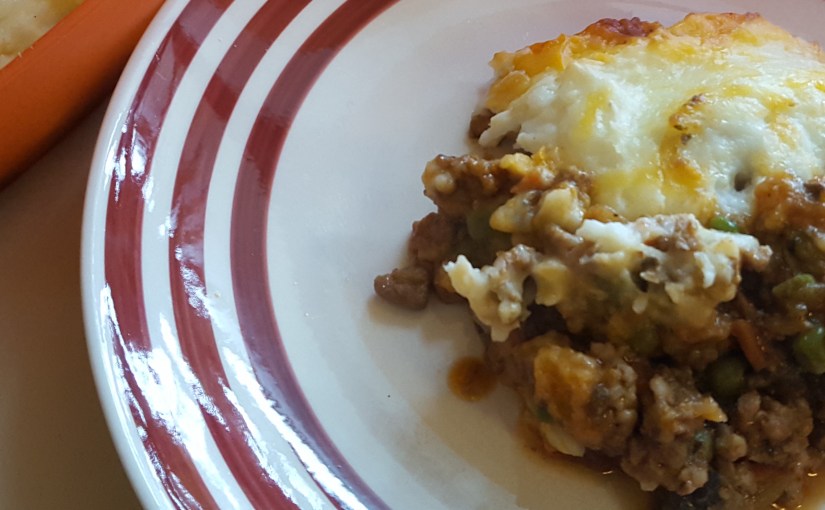
Comfort food is delightful in the winter, when jumpers and jackets cover their calorific side effects. As we enter Spring, however, I try to lighten our meals a little, in anticipation of shorts and vest tops. This recipe is a mid-week crowd pleaser; not cottage, not shepherd’s, but porky pie. It’s a quick, healthy meal that doesn’t take more than 30 minutes from fridge to table.
Ground pork is lovely and lean, but still has fabulous flavour if you give it a chance to brown. I add chopped mushroom to the meat to add volume, texture and flavour, but the kids would never know it! This is a gluten-free recipe that could be vegetarian if you use Quorn instead of meat. The usual carrots and peas add even more veg, texture and freshness to this delicious favourite.
My kids aren’t fond of white potato mash – they prefer sweet potato, so I’ve made this with sweet potato mash many times and it’s wonderful. This recipe is more traditional, with white or yellow potato mash on top, but if you’re really pressed for time midweek, you can use instant mash potatoes to top the meat. This saves peeling, boiling and mashing yourself, and only involves the kettle and a bowl. For families with less pernickety children, the instant mash is a real timesaver, and adding a little dollop of crème fraiche or soured cream makes all the difference for the taste. The pork gravy tastes amazing no matter how you top it!
You’ll need:
1lb ground pork
1 cup chopped white onion (I use frozen)
2 tablespoons Worcestershire sauce
1 cup chopped brown mushroom
1 cup chopped or grated carrot
1 teaspoon garlic powder
1 teaspoon dried oregano
½ teaspoon chicken stock concentrate, or ½ cube dried chicken stock
1 teaspoon tomato paste
1 cup frozen sweet peas
Optional 1 additional tablespoon Worcestershire sauce near the end
Salt and pepper to taste
4 cups of white potato mash (if not using instant)
3-5 medium russet potatoes
1 cup low fat milk
1 tablespoon salted butter
Salt and pepper to taste
Optional ½ cup shredded cheese
The method:
If you’re making your own mash, get a pot of water on the cooker to bring to the boil, and wash and quarter your potatoes so they’re ready to add to the water straight away.
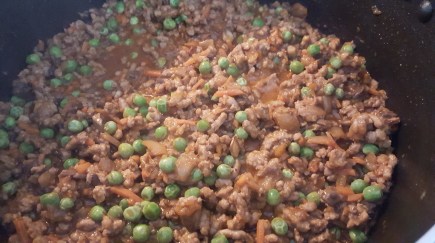
Choose a nice wide pan for browning your meat and bring it to a medium-high heat. Add the chopped onions, ground pork and Worcestershire sauce and mix together, breaking up the meat and distributing the onions and sauce.
Leave the meat for a good 2 minutes to allow one side to brown deeply. Resist the temptation to stir as you want the flavour to stick. This is a great time to chop mushrooms and carrots.
Add the dry spices to the meat before your next stir and coat the meat before leaving it for another 2 minutes.
Add your chopped mushroom and carrot once the meat is mostly browned and mix into the mixture well.
Next, add the chicken stock and tomato paste, and perhaps a splash of water to help dissolve, but the meat and veg will have produced a bit of liquid to help stir into the gravy.
Add the frozen peas and distribute into the mixture, reduce the heat to medium-low and cover. Allow the mixture to simmer covered for about 10 minutes.
While the meat is simmering, whip up your mash with either the kettle water and packet, or the boiled potatoes you’ve drained in the sink. If making from-scratch mash, I add the boiled potatoes back to the pan with the butter and use a fork to smash. I add 1% milk, and salt and pepper to taste. The handful of shredded cheese is optional, but adds colour and creaminess.
After about 10 minutes, taste the pork and add one more splash of Worcestershire to taste. I love the flavour, so add that last minute splash before it goes into the oven. You’re fine to use salt and pepper to taste if you prefer.
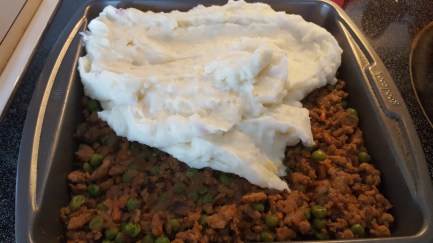
Pour the meat mixture into the bottom of a baking dish (I use a square non-stick) and cover with your mash.
Slide the pie into a preheated oven at 200C/400F for about 15 minutes. It doesn’t take long for bubbles, so an additional baking tray underneath is advised. Allow the pie to cool slightly before serving and enjoy!
I’ve seen a few people around lately asking about what diets worked for people, and even specifically about the 5:2 diet, also known as The Fast Diet. So I thought I’d write a little piece about my experience with the diet and some tips to help you if you decide to try it.
I first heard about the diet in February 2013. I had just returned to work after having my first son, and I weighed about 200 pounds (just over 14 stone). For me, that was not a comfortable weight. At lunch one day, some of my colleagues started talking about this diet where you eat just 500 calories (600 if you’re a man) for 2 days of the week, and eat normally (2000 calories/day ideally) the rest of the time.
I thought it sounded like such a ridiculous fad diet, and possibly even dangerous. I also thought I would be extremely grumpy if I didn’t eat enough in a day, and possibly even wouldn’t be able to function.
And because this is the sort of person I am, I decided to read a book about the diet. Just so I could tell my colleagues that I read it and still think it’s rubbish. So I bought the Kindle version of The Fast Diet by Michael Mosley. He is the guy off of the TV show, Trust Me, I’m a Doctor, and one of the originators of the 5:2 craze. He tested out the science of intermittent fasting by doing it on himself, and the book lays out his findings.
It was utterly convincing. I gave the book to my husband – who is the biggest sceptic you could ever meet – and he thought it was great too. We decided to do it together.
It took me about 9 months to lose 20 pounds (about 1.5 stone) the first time I tried it. Then I got pregnant with my 2nd son and gained it all back. I started again when I stopped breastfeeding my 2nd, and again lost the 20 pounds. So the weight loss is slow, but that is what makes it sustainable. You will also see from the book that there are other reported health benefits, such as lowering your risk of cancer and diabetes.
I don’t have much in the way of before and after photos, as like a typical mum, I’m not in many of the pictures, especially full-length ones. But here I hope you can see the difference in my face, from April 2016 to now.
April 2016
March 2017
So I’ll let you read the book for yourself – it’s a quick read – but here are two lists from me. One with the pros and cons of the diet (and I think the pros far outweigh the cons), and another with a few tips for getting started.
Pros & cons of The Fast Diet
Pros
It works around your social life. You don’t have to be the one who can’t drink or have anything on the menu on your night out. Just plan your low-calorie days to work around your life. Ideally, they should be on non-consecutive days of the week, but it doesn’t really matter.
It doesn’t cost a lot of money. So many diets require subscriptions, or for you to attend groups or buy specialty foods. This diet isn’t trying to sell you anything (except maybe the recipe books, but they’re not necessary). We found that we even spend less money on food generally because we are eating less!
It can work around your family. You don’t need to eat a separate meal from everyone else. The diet works on the premise that in order to keep yourself feeling good on your low-cal days, you should eat mostly plants and protein. So a fast day meal might be some chicken and vegetables. This can easily be adapted for the rest of your family by adding some rice or potato. And, once again, it’s only twice a week – so it won’t really hurt the non-dieters to just eat the same as you.
It resets your eating habits. I found that it changed the way I ate even on my “normal” days. I’m less hungry all the time and my appetite is smaller. I don’t get ridiculously hungry between meals and mostly forget to snack! I’ve found it’s easier now to ask myself if I’m really hungry before I eat, rather than just bored or emotional.
It improves concentration. You might think that not eating will make you tired or cause you to have difficulty concentrating. But I (and many on the diet) have found that I concentrate better on my fast days.
It’s a diet for people who love food. I haven’t had to give up a single food that I love. I’m still allowed cake, chocolate and alcohol! It’s only 2 days/week that I restrain myself. And there are still delicious things to eat on those days, with just a bit of effort. Just don’t totally binge on your non-fast days.
You don’t have to obsess over counting points/calories/planning meals, etc. I’ve tried loads of other diets, like Weight Watchers, and if anything they made me more obsessed with food. Constantly counting calories and thinking about everything I put in my mouth is not for me! On this diet, I just plan 2 low-cal meals per day for 2 days per week.
Cons
It still requires willpower. I’m not going to lie. It’s not always easy when, for example, your neighbour drops by on a fast day with a beautiful piece of chocolate cake. Or when you’re having a really bad day. But just try and wait until tomorrow to indulge. And if your willpower fails, you can always fast on a different day!
It still requires planning. You do have to be careful about what you eat on fast days. You need to eat vegetables and protein in order to feel full. Crisps, chocolate or other junk food is going to use up your calories quickly and leave you starving.
The weight loss is slow. I only lose about 2 pounds per week. And some weeks nothing. It did take me about a year to lose those 20 pounds. But they say that the most sustainable weight loss is when you’ve lost it slowly.
Sometimes I feel cold or get a headache. The headache means I’m not drinking enough water. You get lots of your water from food, so you need to drink more if you’re eating less. I think the cold is just par for the course. Cardigans and hot tea seem to fix it!
Tips for getting started and carrying on
Think about when you’re going to eat on fast days
Some people have breakfast and then eat again at dinner time. Some people starve all day and eat all their calories at dinner time. I like to eat lunch and dinner. I find it easy to skip breakfast, and actually that eating breakfast makes me more hungry over the day. So experiment and see what works for you. Also think about what fits into your lifestyle.
Think about when you’re going to fast
As I mentioned already, this is totally flexible and can be different from week to week. Just consider whether you find it easier doing some things than others. I find it difficult when I’m with my kids because they’re constantly eating, but if I’m working I just focus on that and forget about food.
Think about what you’re going to eat on fast days
It’s good to start out with a few meals planned. If you’re having 2 meals in the day, it’s probably best to have one 200-calorie one, and another 300-calorie one.
You can get lots of recipes for free on the internet by searching for 5:2 diet recipes or recipes with the calorie value you’re looking for. The Hairy Bikers do some good ones. I also highly recommend the Fast Diet cookbooks, The Fast Diet Recipe Book and The Fast Cook. There are loads of other books out there though.
Finally, it’s also worth noting that you can eat convenience food on fast days. If I’m at home, my lunch will usually be two eggs quickly scrambled with 1-calorie cooking spray and no milk. I stick some salt and chili sauce on top for a quick 200-cal lunch. There are many tinned soups that are 200 calories (Baxter’s Hearty have a few nice chunky ones). You can eat a pretty massive amount of salad with chicken or tuna on top for 200 calories. And you can even get diet microwave ready meals.
I also work in London two days per week and buy lunch out. Pret a Manger, Itsu and Crush all list the calories of their food in the shop so you can pick something appropriate. Pret’s Tuna Nicoise salad with a squeeze of lemon and salt is very filling and less than 200 calories. You can also check most food shop’s websites to see if they have any low-cal options.
Drinking is your friend
No, I don’t mean booze on this occasion (sorry). I mean keep yourself hydrated on your fast days. Keep a bottle of water with you. You can even use one of those fruit infuser things to keep it interesting. Sparkling water with a dash of lemon juice is a good option. You can drink unlimited coffee, tea and herbal tea, as long as you don’t add sugar. If you add milk, try to be sparing as this can rack up the calories. You can use artificial sweeteners if you really need sweetener, but it’s better not to.
If I’m really struggling on a fast day, I do give in and have a diet (zero calorie) soft drink. This is not encouraged but allowed. The sugary flavour really helps me feel fuller.
Get support
See if your partner or a friend will join you at least in eating a fast day meal even if they don’t fast all day. It will be good for them too and great to have support. I also recommend The Fast Diet website. It’s got forums where you can connect with other Fast Dieters and even track your progress if you want.
Be kind to yourself
I’m not going to lie. The first 2 weeks can be tough. But if you stick with it for that long, it will get easier. And if you have a bad week or are sick and can’t do it, this diet has absolutely no guilt. Just pick up fasting again when you’re ready.
Are you convinced?
I should mention that I’m not trying to sell you anything here. This is NOT a sponsored post and I have nothing to gain from you going on this diet. I just wanted to share what worked for me (and is still working, albeit slowly), after years of unsuccessfully searching. I hope you’ve found this useful, and if you have any questions, I’ll be happy to answer them in the comments.
Please note that this is not medical advice and you should check with a doctor before starting a new diet plan.
Not something I ever had aspirations of being, but life hands you cards sometimes and you don’t get a choice.
I’d had some experience with epilepsy already, after my sister tragically lost her life at 26. It’s also something many people I know have, including friends and my niece and nephew.
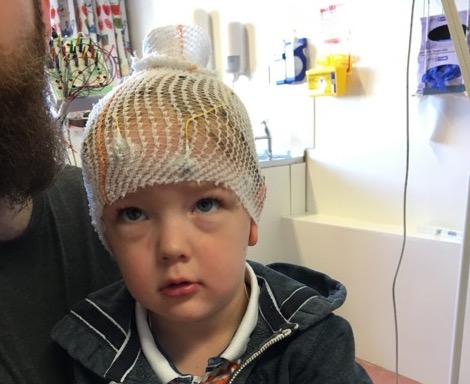
Dexter’s first fit was completely out of the blue. We were at my sister-in-law’s house and he was playing on the floor with the trains. He was laying there quite happily at first and then something went wrong.
To give you an idea of what his first fit was like, here is an excerpt from my blog, from the post I wrote after that first one:
“He lay on the floor as kids often do and then arched his head backwards as though he was trying to look at the cat but then he started twitching. We called out to him but he didn’t respond. At first I thought he was just playing. You know, just not answering us because he was being cheeky but we all got down to the floor and quickly realised that he was not messing about. Liam got his phone out and turned the torch on. He shined it in Dexter’s eyes. His pupils weren’t dilating. His hands, feet and eyebrows were twitching and shaking. I called 999 while Liam continued to call out to him and bring him round.”
I can’t fault the ambulance for how quickly they responded. They were with us before the fit had even ended. They did some tests, tried to bring him round and after we answered a few questions about what happened, we decided he was going to hospital.
Dexter started to return to his normal self once we were stood waiting to be seen in A&E. Liam parked the car and came to find us.
We were taken to a bed where many more doctors and nurses repeated the same questions: what was he doing when it happened? How long did it last? Has he been ill recently? Etc.
On eventually leaving the hospital either very late that night or early the next morning, we were advised to call our GP first thing on Monday and get a referral for a neurologist.
We did this and had an appointment booked for a couple of week’s time.
Already, based on the info we had provided and the notes from the hospital staff, our neurologist was pretty convinced that it was epilepsy, but wanted to run some tests before medicating, just to be sure.
Over the next few weeks, he suffered some more fits so we were sent to Addenbrooks for an MRI as well as having an ECG at Peterborough.
Both tests were inconclusive. By now, they knew it was epilepsy but weren’t able to pinpoint a cause or a trigger. But at least we were able to get him on some medication.
I’ve cried so many times. Watching my sister spend a week in a coma after a seizure caused her to stop breathing, and then being at her bedside when she passed away, makes the reality of what could happen to Dexter so much more real. It’s scary and I wouldn’t wish it on anyone. Not having a trigger or a known cause of his fits makes it harder because we don’t even know what to avoid. I don’t dare take him swimming; he worries me every time he has a bath, and with most of his fits having been at night time, I’m scared every night when he’s in bed. We have an anti-suffocation pillow for him and monitors in his room, so he’s about as safe as he can be, but it’s always there in the back of your mind.
There are many types of epilepsy. The one most people think of is photosensitive epilepsy, whereby the sufferer is affected by flashing lights or strobe effects.
Some people have full on tonic clonic seizures. This is what Dexter has but we don’t know what causes it. It’s all very random.
There is also another type of epilepsy, which both my nephew and my friend have, where they don’t “fit” as such, but they black out momentarily and come round having little or no knowledge of what happened. My nephew has actually done this several times while crossing the road or while just walking along outside.
Each form of epilepsy, although common (I’m sure it’s 1 in 4 people suffer with it in some form) is hard to live with. As I mentioned, it’s hard for me to even bathe Dexter at times because he could fit at any given moment, and in or around water would be especially dangerous.
He’s on daily medication at the moment, and for now we seem to have his dosage right, as he’s not had a fit since November. That was a particularly hard one, though, as he had 3 in the space of four hours, one of them being when he had gone to the shop with Liam and was walking home. It happened in the middle of the street and I felt such immense guilt that I wasn’t there.
But still, in the back of my mind, I’m wondering if the medication is keeping them at bay or because we haven’t had one for a while, is one due at any moment?
Sadly it’s just one of those unpredictable things.
If you do happen to be around when someone has a fit, there are things you can do to help and keep them safe:
cushion their head if they’re on the ground
move them away from anything that could cause injury – such as a busy road or hot cooker
loosen any tight clothing around their neck – such as a collar or tie, to aid breathing
when their convulsions stop, turn them so that they’re lying on their side
stay with them and talk to them calmly until they have recovered
note the time the seizure starts and finishes
Do NOT put anything in their mouths
If the seizure lasts more than 5 minutes, call an ambulance.
I hope this post has helped to inform at least one person on what it’s like living with a child with epilepsy. And if any information has helped to raise awareness in anyway, then I’ve done my job.



















 The Mum Reviews